Anglesey, Traeth yr Ora, and Why I Wrote The Anglesey Dead
How childhood summers on Anglesey — and one quiet beach called Traeth yr Ora — became the setting for a British zombie survival thriller about an island that has to close its bridges to survive.
Why an island?
When I started planning a new British zombie survival thriller, I knew I didn't want it set in another collapsing city. I wanted somewhere small. Somewhere with edges you could see. Somewhere that had a real, physical line between safe and not safe.
I wanted an island.
And not just any island. I wanted the island I'd known since I was a child: Anglesey — Ynys Môn — sitting off the north coast of Wales, cut off from the mainland by the narrow, fast-running Menai Strait.
That stretch of water is only a few hundred metres across in places. Two bridges connect the island to the rest of Britain: the Menai Suspension Bridge and the Britannia Bridge. For most of my life they were just the way we got on and off. But the more I thought about them, the more I realised they were something else too.
They were a line. A threshold. A place where, if things ever went wrong, somebody might have to make a decision.
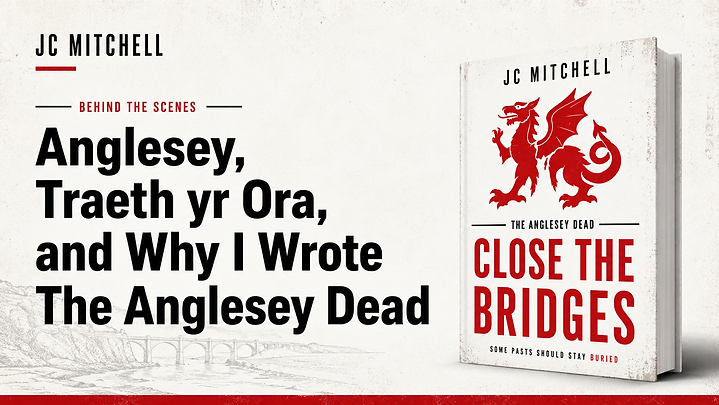
That decision became the first book: Close the Bridges.
A childhood on the coast
I spent parts of my childhood on Anglesey, and the island got under my skin early. It's the kind of place that teaches you about edges. There's the edge of the land and the edge of the sea. The edge of the tourist season and the long, quiet edge of winter. The edge of the Welsh-speaking villages and the edge of the holiday towns.
You learn quickly that an island is a defined thing. You can't keep walking forever. Sooner or later the road runs out and there's water, and the water doesn't care what you'd planned.
I think that's why zombie stories always felt, to me, like they belonged somewhere like this. The apocalypse is really a story about a shrinking world — about safe places getting smaller. And an island is a world that's already small. It's already got its edges drawn.
The only question is whether you can hold them.
Traeth yr Ora
Of all the places on Anglesey, the one that sits heaviest in my memory is a beach called Traeth yr Ora.
It's not the most famous beach on the island. It's not the one on the postcards. You have to want to find it. There's a walk involved, and the path drops you down through trees and rough ground until the ground opens out and there it is — a crescent of pale sand, backed by low cliffs, with the sea coming in clean and clear over a shelving bottom.
As a child it felt like a secret. Like somewhere the rest of the world hadn't quite noticed.
I remember the sound of it more than anything. The way the water moved over the sand in a slow, breathing rhythm. The way the wind came in off the strait and the gulls kept their own counsel. The way, when the tide was right out, the beach seemed to go on forever, and when it came back in it came back quickly, as if the sea had changed its mind.
I remember being told, as a child, to watch the tide. Don't get cut off. It was the first time I understood that a place could be safe and dangerous at the same time — that the same water that made the beach beautiful was also the thing that could trap you there.
That idea never left me. And when I came to write The Anglesey Dead, it came back.
The sea is not a wall
The premise of the series is simple. When the outbreak tears through North Wales, Anglesey has one chance: close the two bridges to the mainland, and let the sea hold the line.
It's a hopeful plan. It might even work — for a while.
But the thing I learned at Traeth yr Ora is that the sea is not a wall. It's a border that moves. It gives and it takes. It changes its mind twice a day and never apologises.
So in The Dead Ashore, the bridges are closed and the island begins to believe it's safe — until bodies start washing up on the beaches. In No Safe Water, the threat comes by boat. In The Island Divides, the living start tearing each other apart long before the dead get through. And in The Last Crossing, the island has to decide whether to risk opening the route it once fought so hard to seal.
The sea that was supposed to save them becomes the thing they can't predict.
That's Traeth yr Ora, really. The beautiful, unreliable edge that taught me, before I had words for it, that safety is never as permanent as it looks.
Writing it back to life
There's a strange kind of gratitude in writing a place you love into a story. You don't get to keep it the way it was — you have to let things go wrong there, you have to let the dead walk down the lanes and the smoke rise over the strait. But you also get to put it down on the page. The colour of the light. The weight of the wind. The way the bridges look when the fog comes in and you can only see the first few cables of the suspension wires, hanging in the white air like the bones of something that used to be solid.
Anglesey made me think about edges. Traeth yr Ora made me think about tides. The two of them together made me think about what an island would do if the world ended and the only way to survive was to shut the door.
That's The Anglesey Dead. Five books. One island. A coastline that may be impossible to defend.
I hope, when you read it, you can hear the sea.
Keep reading